
Dresden is 150 kilometres from Prague by road — close enough to reach comfortably in the morning, far enough to feel like a genuine journey into a different world. The Saxon capital sits on the Elbe with a skyline that looks, from across the river, like a stage set designed by someone who had read too many Baroque novels: gilded domes, spires, the curved gallery of the Zwinger, the green copper of the Hofkirche. It was mostly rebuilt from rubble after 1945, which makes the fact that it looks this way again one of the more extraordinary feats of post-war reconstruction in Europe.
A private day trip from Prague gives you more than just Dresden. Depending on what interests your group, the route can include the sandstone formations of Saxon Switzerland, a fortress on a rock above the Elbe, a fairy-tale castle that starred in one of the most beloved films in Czech cinema, or the town where European porcelain was invented. None of these requires much extra time — they sit naturally along the road — and a private car means you stop where you want, not where a bus schedule allows.

Dresden: What You Actually Come to See
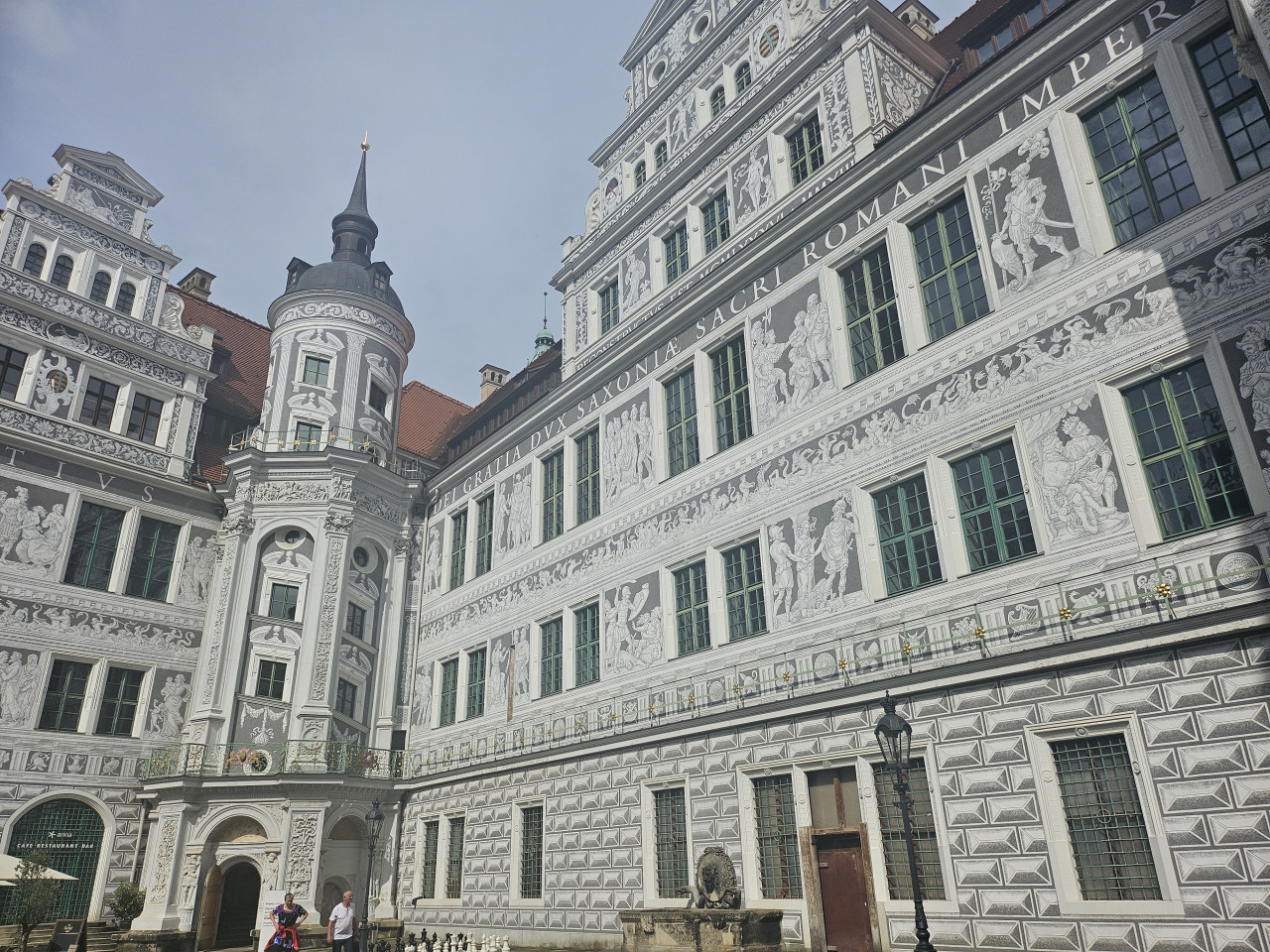
The centre of Dresden is compact enough to cover well in four to five hours on foot. The main area — the Altstadt — is concentrated around the Elbe embankment and can be walked end to end in twenty minutes, which means you have time to go slowly, go inside things, and sit somewhere with a coffee rather than rushing between checkpoints.
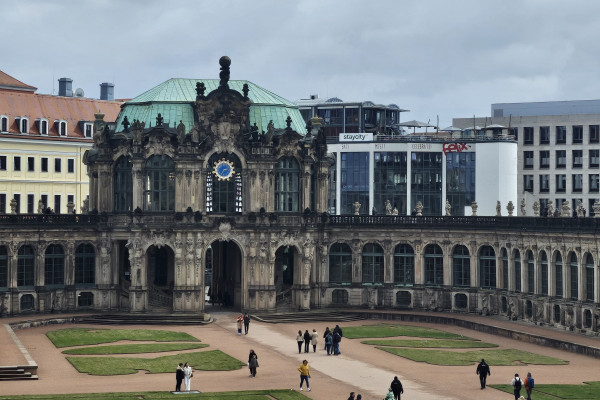
The Zwinger is the starting point for most people, and reasonably so. It is one of the finest Baroque palace complexes in Europe — an open courtyard surrounded by galleries, fountains, and ornamental gates, built for the Elector of Saxony in the early 18th century. The Old Masters Picture Gallery inside holds Raphael's Sistine Madonna, along with Vermeer, Rembrandt, Titian, and Rubens. The porcelain collection next door is among the largest in the world.
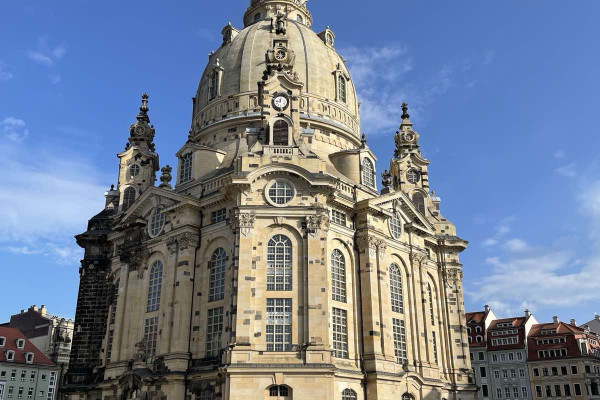
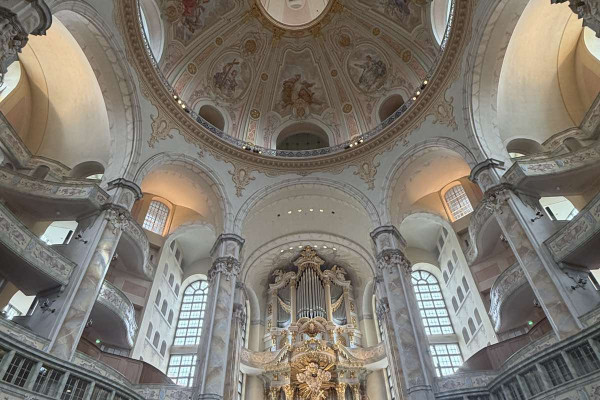
The Frauenkirche — the Church of Our Lady — is the centrepiece of the skyline. It was destroyed in the 1945 bombing raids and remained a ruin for 45 years, left deliberately uncleared in East Germany as a war memorial. Reconstruction began in 1994 and was completed in 2005. The rebuilt church is extraordinary: from inside, it reads as a single curved space, all pale stone and light, with the dome rising directly above. The rebuilt sections of the original stone — still darker than the new — are visible throughout.
Brühlsche Terrasse, the elevated terrace along the Elbe known as "the balcony of Europe," connects the major landmarks and gives the best views back across the river to the Neustadt. It is the best place to understand why Dresden's skyline looks the way it does — and how comprehensively it was destroyed and then reconstructed.
Beyond Dresden: What Else You Can Add
This is where a private tour is genuinely different from any group excursion. The route from Prague to Dresden passes through Saxon Switzerland and along the Elbe — and along that route sit some of the most remarkable places in the region. You do not need to choose between seeing Dresden and seeing these places. With an early start and a sensible itinerary, you can combine two or three of them in a single day.
Bastei Bridge and Saxon Switzerland
Saxon Switzerland is the German continuation of the Bohemian Switzerland national park — the same sandstone landscape, the same vertical rock formations rising from forest, the same sense that you have driven into somewhere that looks nothing like the rest of Central Europe. The Bastei is its most famous viewpoint: a series of sandstone pillars connected by a stone bridge, standing 194 metres above the Elbe, with views across the valley that are routinely described as dramatic and are, in this case, actually dramatic.
The walk from the car park to the bridge takes about twenty minutes. From the bridge, the view extends across the Elbe to the Königstein plateau and, on clear days, deep into Bohemia. It is one of those places that photographs well but is considerably better in person.
Königstein Fortress
Königstein sits on a flat-topped plateau above the Elbe, a few kilometres from Bastei. The fortress is one of the largest and most impregnable in Europe — it was never taken by assault, was used at various points as a royal treasury, a state prison, and a prisoner-of-war camp. The scale of it is impressive: the plateau is enormous, the walls are metres thick, and the views from the top take in the full sweep of the Elbe valley and the Saxon Switzerland landscape below.
Bastei and Königstein are close enough that visiting both on the same stop adds about an hour and a half to the journey. If the group has children or an interest in military history, Königstein is particularly worth adding.
Moritzburg Castle — The Cinderella Castle
Moritzburg is 14 kilometres northwest of Dresden: a Baroque hunting castle built on an artificial island in a lake, surrounded by forest, with four round towers reflected in the water on every side. It is one of the most photogenic buildings in Saxony, and in the Czech Republic and Slovakia it is known by a different name entirely.
The 1973 Czechoslovak film Tři oříšky pro Popelku — Three Nuts for Cinderella — was filmed partly here, and has been broadcast on Czech and Slovak television every Christmas for over fifty years. For anyone who grew up watching it, arriving at Moritzburg is a recognisable moment: the castle looks exactly as it did in the film. The winter version of that visit, with snow on the lake and frost on the trees, is something else entirely.
Moritzburg adds about an hour to the itinerary and is close enough to Dresden that it fits naturally at the end of the day, on the way back toward the motorway.
All girls must try on the glass slipper — the one that was left on the castle steps and never claimed. Local legend has it that if the slipper fits, your prince will find you. It has been working since 1973.
Meissen — Capital of Saxon Porcelain
Meissen is 25 kilometres upstream from Dresden on the Elbe, a small town that has been making porcelain since 1710 — the first European manufacturer to crack the formula that the Chinese had guarded for centuries. The Meissen factory is still operating. The porcelain museum on site holds the largest collection of Meissen pieces in the world, from the earliest experimental pieces to contemporary production.
The old town above the river is a separate reason to stop: a medieval hilltop with a Gothic cathedral and a castle, largely untouched by the 20th century, with views across the Elbe and the vineyards that produce Saxony's wine. Meissen adds about two hours and works best combined with a morning stop at Bastei or Königstein, leaving Dresden for the afternoon.
How to Plan the Day
The route gives you genuine flexibility. A full Dresden-only day works well for people primarily interested in art, history, and the city itself. Adding Bastei or Moritzburg extends the day without significantly increasing the drive time. Adding all four — Bastei, Königstein, Moritzburg, and Meissen, with Dresden — is possible but makes for a full day with less time at each place.
The most common combinations:
- Dresden + Bastei — city and landscape, morning stop at Bastei, afternoon in Dresden
- Dresden + Moritzburg — city and the Cinderella castle, works well in one day
- Dresden + Meissen — two towns, art and porcelain, more relaxed pace
- Bastei + Königstein + Dresden — Saxon Switzerland in the morning, city in the afternoon
We discuss the itinerary with every group before the tour and plan the day around what interests you. There is no fixed programme — the driver and guide know the route and the timing, and adjust as needed.
Practical Information
Distance from Prague: approximately 150 km, 1 hour 40 minutes by car on a good day.
Duration: 10–12 hours, depending on the itinerary. We leave Prague in the morning and return in the evening.
Price: from €550 per group (up to 5 persons) · €850 per group (up to 10 persons). The price covers the car, driver and a licensed English-speaking guide, hotel pickup and drop-off in Prague. Entry fees to museums and attractions are paid separately on site.
Group size: up to 5 persons in a standard car. Larger groups can be accommodated with a minivan — ask when booking.
Payment: cash on the day of the tour. No prepayment or deposit required.
Cancellation: free cancellation up to 24 hours before the tour.
Passport: bring it. The Czech Republic and Germany are both in the Schengen Area and there are normally no border checks — but Germany has periodically reintroduced temporary controls, and border police do occasionally check documents. A national ID card is sufficient for EU citizens; non-EU travellers should carry their passport.
Cash in euros: Germany uses the euro — unlike the Czech Republic, where the currency is the koruna. Public toilets in Dresden and at tourist sites typically charge €0.50–1.00, payable by coin only. Bring a few euro coins. Card payments are widely accepted in restaurants and shops, but coins are essential for toilets.
The Czech Republic and Germany are both in the Schengen Area, so routine border checks do not apply — you will usually cross without stopping. However, Germany periodically reintroduces temporary border controls, and document checks do happen. Always bring your passport. EU citizens may use a national ID card; non-EU travellers should carry their passport. Citizens of countries that require a Schengen visa for the Czech Republic are already covered for Germany on the same visa.
Why Book a Private Tour Rather Than the Train
Dresden is reachable by direct train from Prague in about two hours, and the train is a perfectly reasonable way to get there if you want to spend the day in Dresden and only in Dresden. The train does not stop at Bastei. It does not stop at Moritzburg. It does not stop at Meissen or Königstein. And it leaves and arrives on a fixed schedule that does not adjust to what your group actually wants to do.
A private tour costs more than two train tickets. What you get in return is a full day that can include four destinations instead of one, a guide who knows what to prioritise at each stop, a car door to door from your hotel, and the flexibility to spend more time at the places that matter to you and less time at the ones that do not.
For a group of two, the cost per person is similar to a first-class train return. For a group of four or five, a private tour is less per person than first class — and considerably more than it in terms of what you actually see.