
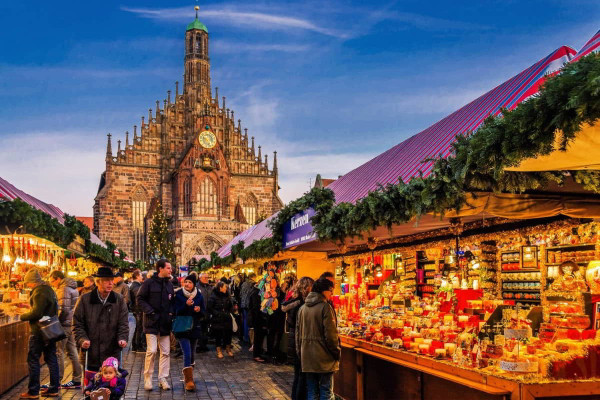
Not all Christmas markets are equal. Nuremberg's Christkindlesmarkt — held in the Hauptmarkt, the medieval main square at the heart of the old town, surrounded by the red-and-white striped market stalls and overlooked by the Gothic Church of Our Lady — is in a category of its own. It is one of the oldest Christmas markets in Europe, one of the most atmospheric, and one of the few where the market itself is a reason to make a journey rather than a convenient local tradition. From Prague, it is 3.5 hours by car.
The Christkindlesmarkt — What to Expect
The market opens on the Friday before the first Sunday of Advent — in 2026, that is 27 November — and runs through 24 December. It operates daily from 10:00 to 21:00, with the exception of the opening day (17:00 start) and 24 December (10:00–14:00). Around 180 stalls fill the Hauptmarkt, selling handmade decorations, wooden toys, traditional crafts and, above all, food.
The opening ceremony on the first Friday is the most theatrical moment: the Christkind — a young woman dressed as a golden-haired angel, elected for the role by a jury and representing the spirit of Christmas — reads a Prologue from the balcony of the Frauenkirche to the crowd assembled below. It is a tradition that dates to 1948 and is entirely specific to Nuremberg. If you are there on the opening day, it is worth timing your arrival for it.
What to Eat and Drink
Nuremberg has its own Christmas food traditions, and they are worth understanding before you arrive.
Nuremberg Bratwurst. Small, thin sausages — about the length of a finger — made to a recipe specific to the city and protected by EU geographical indication. They are served in groups of three or six in a bread roll, grilled over beechwood. You will find them at stands throughout the market. Do not confuse them with the larger Thuringian bratwurst — the Nuremberg version has a particular marjoram flavour and a different texture. Try them at the market before you try them in a sit-down restaurant.
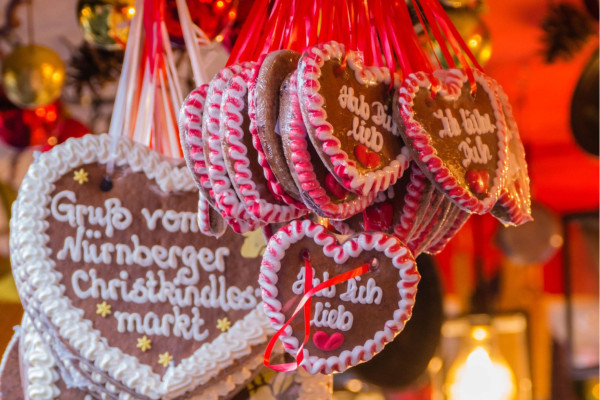
Lebkuchen. Nuremberg's other protected product — a spiced gingerbread that has been made in the city since the 14th century. The Hauptmarkt has stalls from the historic Nuremberg Lebkuchen manufacturers (Lebkuchen Schmidt, Wicklein, and others) selling the full range: glazed, chocolate-dipped, plain, in decorative tins. Buy some to take home; they travel well and last.
Zwetschgenmännle. Figures made from dried prunes, walnuts and figs, assembled into little people with wire frames — a craft specific to Nuremberg and one of the more charming things the market sells. They make good presents and are entirely unlike anything sold at other markets.
Glühwein. The standard hot mulled wine of German Christmas markets, served in the market's own mugs (you pay a deposit, return the mug for a refund or keep it as a souvenir). Nuremberg also serves Kinderpunsch — a non-alcoholic warm spiced fruit drink — for children.
Market dates 2026: 27 November – 24 December
Hours: daily 10:00–21:00 (opening day from 17:00; 24 Dec until 14:00)
Location: Hauptmarkt, Nuremberg old town (Altstadt)
Beyond the Market — Nuremberg Old Town
The Christkindlesmarkt is the centrepiece, but Nuremberg's medieval old town is substantial enough to fill a full day. The city was heavily bombed in 1945 and then carefully rebuilt on its original street plan, so the Altstadt today is a reconstruction — but an exceptionally faithful one, and the result is one of the most complete-feeling medieval city centres in Germany.
Nuremberg Castle (Kaiserburg). The imperial castle that rises above the old town on a sandstone ridge was the official residence of Holy Roman Emperors for centuries. The view from the castle terrace across the red-tiled rooftops to the surrounding countryside is the classic Nuremberg view, particularly striking in December when there is snow. The castle itself is open in winter (reduced hours); the exterior and terrace are accessible year-round.
St Lorenz Church. The Gothic church at the south end of the old town, a few minutes' walk from the Hauptmarkt. The interior contains the Englischer Gruß — a carved lime-wood Annunciation by Veit Stoss, suspended from the vault — which is one of the finest pieces of late Gothic carving in Germany. Worth ten minutes on any Nuremberg visit.
St Sebaldus Church. The older of the two main churches, immediately adjacent to the Hauptmarkt. The shrine of St Sebaldus behind the altar is a remarkable piece of 16th-century bronze casting by Peter Vischer.
Albrecht Dürer's House. Nuremberg was the birthplace of Albrecht Dürer (1471–1528), and his house — a half-timbered Gothic building on Tiergärtnertor square, a short walk from the castle — is preserved as a museum. Dürer is the reason Nuremberg appears in so many art history books, and the house gives a clear sense of how a successful craftsman lived in 15th-century Germany.
Getting from Prague to Nuremberg
The distance from Prague to Nuremberg is approximately 350 kilometres. By car, the journey takes around 3.5 to 4 hours, travelling west on the D5 motorway through Rozvadov and into Germany, then south to Nuremberg. The road is straightforward and well-maintained; the German section of the motorway (A6, then A9 or A3) is fast.
A day trip is feasible — departure from Prague at 7:00–7:30am, arrival in Nuremberg by 11:00–11:30am, five to six hours at the market and in the old town, departure by 18:00, back in Prague by 22:00. It is a long day, but Nuremberg repays it.
An alternative is to combine Nuremberg with Regensburg — a beautifully preserved medieval city on the Danube, roughly on the route between Prague and Nuremberg. Regensburg has its own Christmas market in the inner courtyard of Thurn und Taxis Palace, and two markets in one day is perfectly manageable. Ask your guide about this option when booking.
Practical Tips
Weather in Nuremberg in December. Colder than Prague — average temperatures between −2°C and 4°C, with snow possible from mid-December. Dress for standing outdoors for extended periods: thermal base layer, warm coat, waterproof boots, hat and gloves. The cold is part of the atmosphere; come prepared for it.
Book the opening weekend. The first weekend of the market (28–29 November 2026) is one of the best times to visit — the stalls are fully stocked, the atmosphere is at its most festive, and the opening ceremony on the Friday is a unique event. It is also the busiest weekend; if you prefer quieter conditions, the second and third weeks of December are better.
Parking. If you drive independently, use one of the city-centre car parks (Hauptmarkt area is pedestrianised in December). A private day trip solves the parking question — your driver handles it.
Other Christmas markets nearby. The Königstein Fortress Christmas Market and the Dresden Christmas Market are both excellent alternatives from Prague if Nuremberg feels too far for a single day.
Frequently Asked Questions
How far is Nuremberg from Prague?
Approximately 350 kilometres by road — about 3.5 to 4 hours by car, depending on traffic at the border and on the motorway. The route is straightforward: the D5 from Prague to the German border, then the A6 and A9/A3 to Nuremberg.
When does the Nuremberg Christmas Market open in 2026?
27 November 2026 (the Friday before the first Sunday of Advent). It runs through 24 December. Hours are 10:00–21:00 daily, except the opening day (from 17:00) and 24 December (until 14:00).
Is a day trip from Prague to Nuremberg possible?
Yes, though it is a long day. Leaving Prague at 7:00–7:30am gives you five to six hours in Nuremberg before the drive back. The journey is comfortable on the motorway. An overnight stay is also an option if you prefer to take more time.
What makes Nuremberg's Christmas market different?
Several things: the Christkind ceremony on the opening day, the Nuremberg-specific products (bratwurst, Lebkuchen, Zwetschgenmännle), the setting in the medieval Hauptmarkt, and the consistent quality of the stalls. It is one of the few markets where the stall operators are subject to approval by the city — which keeps the quality high and the tourist tat to a minimum.
Can we combine Nuremberg with another city?
Regensburg is a natural addition — it sits roughly on the route from Prague to Nuremberg, has its own Christmas market in the Thurn und Taxis palace courtyard, and its medieval centre is worth an hour or two. Ask about combining both cities when booking.
What should we buy at the Nuremberg Christmas Market?
Lebkuchen (gingerbread in decorative tins — they travel well and last), Zwetschgenmännle (plum-figure decorations, unique to Nuremberg), handmade wooden Christmas ornaments. The bratwurst and Glühwein are for eating there, not taking home.