
Salzburg sits at the edge of the Alps, three hours south of Prague, and it announces itself in a way that very few cities manage: red rooftops below a cliff, a fortress at the top, a river running through the middle, and the mountains visible in every direction. If you have not been before, the first view of the city tends to stop the conversation.
It is compact, extremely beautiful, and — unlike Vienna — small enough to cover properly in a single day. Mozart was born here. The Habsburgs shaped it. The Baroque architects had their way with it for two centuries, and the result is one of the best-preserved historic city centres in Central Europe. Salzburg is also the starting point for Hallstatt, the Salzkammergut lake district, and the Austrian Alps — which makes it both a destination in its own right and a natural base for one of the most rewarding regions in Europe.

How Far is Salzburg from Prague?
Prague to Salzburg is approximately 490 kilometres by road — about five hours of driving on the Austrian and Czech motorways via Linz. By direct train, the journey takes roughly four and a half hours from Prague's main station to Salzburg Hauptbahnhof, with a change in Linz or Salzburg. By plane there is no direct connection; flying requires a connection through Vienna or Munich and takes longer door-to-door than driving.
For a single-day trip, five hours of driving each way is at the outer edge of what is manageable — it leaves roughly four to five hours in Salzburg itself, which is enough for the main sights but nothing more. The more comfortable version is an overnight stay, or the four-day private tour that includes Vienna, Salzburg, and Hallstatt with two nights in Salzburg — enough time to see the city properly and make the Hallstatt day trip at leisure.
Getting from Prague to Salzburg: Private Car vs. Train
The train is a reasonable option if you are travelling alone or as a couple and comfortable navigating independently. The journey is comfortable and the main Salzburg sights are walkable from the Hauptbahnhof. The main disadvantage is inflexibility: fixed departure times mean that a missed train or a longer-than-expected visit to the fortress creates a problem, and the return journey in the evening adds another four and a half hours.
A private car with guide changes the experience substantially. You leave from your Prague hotel at the time that suits you. The drive through south Bohemia and the Austrian Alps is itself part of the trip — the landscape south of Linz is genuinely beautiful. You arrive directly where you need to be, with someone who knows the city, its history, and its best restaurants. And the return is equally flexible: stay until you are satisfied rather than until the timetable says so.
For a group of three or more, private transport is also cost-competitive with first-class train tickets — and considerably more comfortable.
What to See in Salzburg
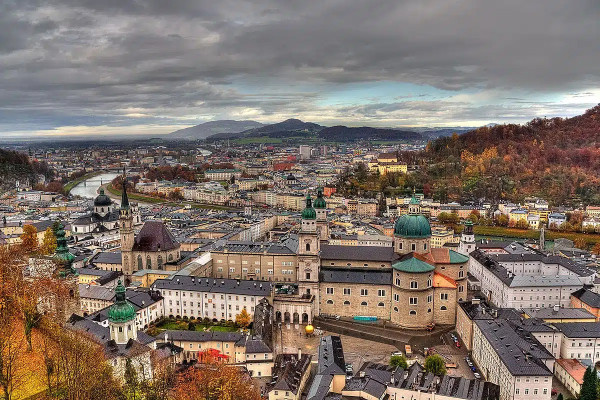
The Altstadt — Salzburg's old town, a UNESCO World Heritage Site — is where you will spend most of your time. It sits on the west bank of the Salzach river, enclosed by the cliff above and the river below, and is almost entirely pedestrianised. Everything worth seeing is within a twenty-minute walk of everything else.
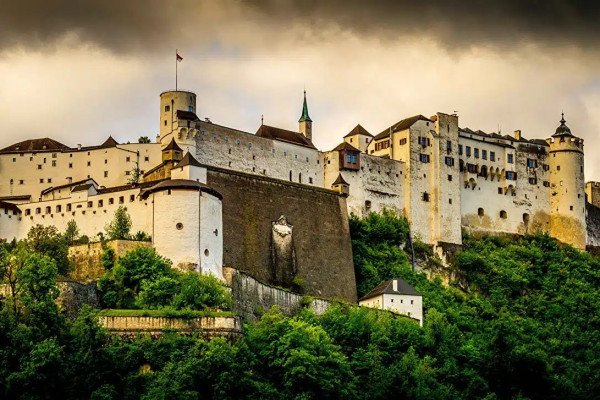
Hohensalzburg Fortress is the centrepiece of the city's skyline and one of the largest and best-preserved medieval castles in Europe. It has stood in roughly its current form since 1077 — built by the Prince-Archbishops of Salzburg, who governed the city as a church state for nearly a thousand years. The walk up takes about twenty minutes through the lanes above the old town; the funicular takes two minutes. The panorama from the top — the city below, the Salzach river, the Alps in every direction — is one of the best views in Central Europe. Your guide will explain what you are looking at and what the long archiepiscopal history meant for the city that grew beneath the fortress.
Getreidegasse is the main shopping street of the old town, lined with the wrought-iron guild signs that have been hanging above the shops since the medieval period. Number nine is Mozart's birthplace — the house where he was born in 1756, now a museum with instruments, portraits, and documents from his life. Whether or not you go inside, Getreidegasse is worth walking slowly: the facades, the signs, the proportions of the street are all exactly as they have been for centuries.
Mirabell Palace and Gardens are a five-minute walk from the old town across the river. The palace was built in 1606 by the Archbishop Wolf Dietrich von Raitenau for his mistress, which was controversial at the time and remains one of the more entertaining biographical details in Salzburg's long history. The gardens are Baroque and formal, arranged around fountains and statues, and were used extensively in The Sound of Music — which means they are recognised by a significant portion of the English-speaking world before the visitor even arrives.
Salzburg Cathedral — the Dom — stands in the centre of the old town and was rebuilt in the seventeenth century after the original burned. It is one of the finest early Baroque cathedrals north of the Alps, with a facade in marble and a nave that gives the interior a sense of height and light that the earlier Gothic building could not have matched. Mozart was baptised in the font by the door.
Hallstatt as a Day Trip from Salzburg
Salzburg is the natural base for a day trip to Hallstatt — the mountain lake village that is among the most photographed places in Austria and, on a quiet morning, one of the most extraordinary. The drive south from Salzburg takes about ninety minutes through the Salzkammergut, the Austrian lake district: a landscape of green hills, clear water, and the particular quality of light that comes from being surrounded by mountains on every side.
Hallstatt sits on a narrow shelf of land between a cliff and the Hallstätter See, a deep blue-green mountain lake. The village has been continuously inhabited since around 5000 BC — one of the oldest continuously occupied settlements in Europe, and the location of the largest prehistoric salt mine ever discovered. The classic view — houses mirrored in the lake, the evangelical church spire rising above the rooftops, the mountain directly behind — is from the ferry landing on the opposite shore.
Arrive before nine in the morning. By midday in summer, the village fills with tour groups and the atmosphere shifts. In the early morning, with almost no one around and the lake still, it is an entirely different experience. We build this into the Salzburg day trip as standard.
We offer a four-day private tour from Prague that covers Vienna, Salzburg, and Hallstatt — the most complete way to experience this route. See our full Vienna, Salzburg & Hallstatt tour guide for a day-by-day breakdown.
Practical Tips for Visiting Salzburg from Prague
Leave early. If you are doing Salzburg as a day trip, departure from Prague at 7:00–7:30 puts you in the city by noon. That gives you four to five hours — enough for the Altstadt, the fortress, and a long lunch, but not a leisurely day. An overnight stay changes the equation significantly.
Currency. Austria uses the euro. The Czech Republic uses the Czech koruna. Bring euros from Prague or withdraw from an ATM on arrival. Exchange offices at the Austrian border and train stations charge high fees.
Carry coins for toilets. Public toilets in Austria charge €0.50–1.00, usually payable in cash — most often by coin. This applies at motorway service stations and at public facilities in the city centre. Have small euro coins ready.
Shops close on Sundays. Austrian retail shops are closed on Sundays and often close early on Saturdays (typically by 17:00–18:00). If shopping is part of the plan, come on a weekday.
Fortress tickets. The Hohensalzburg Fortress charges €15 per person including the funicular. The walk up is free; the interior requires a ticket. Worth it — the panorama and the medieval rooms are both excellent.
Book restaurants for dinner. Salzburg's best restaurants — Zum Eulenspiegel, Carpe Diem, the Stiftskeller St. Peter — fill up quickly, especially in summer and December. If you are staying overnight, book dinner in advance.
Salzburg in December — Christmas Markets
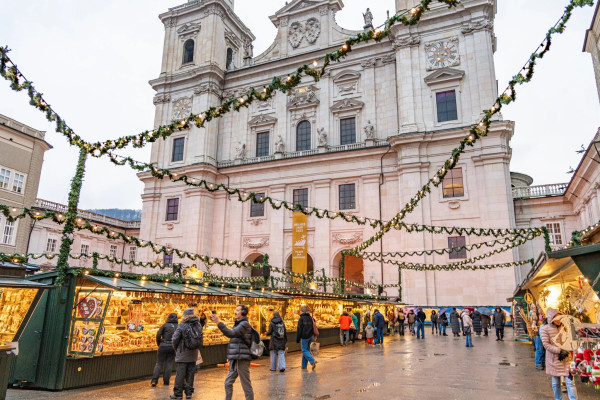
Salzburg in December is one of the finest versions of the city. The Christkindlmarkt am Domplatz — the Christmas market in the Cathedral Square — is one of the oldest in Austria, held in the shadow of the Dom since the seventeenth century. The stalls sell traditional Salzburg crafts, carved nativity figures, beeswax candles, and mulled wine, in a setting — Baroque cathedral, cobbled square, the fortress lit above — that is genuinely difficult to match anywhere in Europe.
December in Salzburg also means far fewer tourists than summer, which means the old town returns to something closer to its everyday self. The coffee houses are quieter. The lanes above the Dom are almost empty in the early morning. The fortress in the snow is considerably more atmospheric than the fortress in the July heat. It is, by most accounts, the best month to visit.
Frequently Asked Questions
How far is Salzburg from Prague?
Salzburg is approximately 490 kilometres from Prague by road — about five hours of driving. By train the journey takes four and a half hours with a change in Linz. There is no direct flight.
Can you do Salzburg as a day trip from Prague?
Technically yes — leave at 7:00, arrive by noon, return by midnight. But five hours of driving each way leaves only four to five hours in Salzburg. It is manageable but tiring. Two nights in Salzburg — as part of our four-day Prague–Vienna–Salzburg–Hallstatt tour — is the version of this trip that people describe as genuinely satisfying rather than rushed.
Is Hallstatt worth visiting from Salzburg?
Yes — and it is one of the most straightforward day trips in Austria, ninety minutes south of Salzburg by private car. The key is timing: arrive before nine to beat the tour buses. Early morning at Hallstatt is one of the most memorable experiences in Central Europe.
What is the best time to visit Salzburg from Prague?
May, June, September, and October offer the best combination of good weather and manageable crowds. July and August are the busiest months — the old town fills up and hotels are expensive. December is excellent for the Christmas market and the atmosphere, with far fewer visitors than summer. April can be unpredictable weatherwise but is quiet and often beautiful.
Do I need a visa to travel from Prague to Salzburg?
Both the Czech Republic and Austria are Schengen countries. EU and EEA citizens need only a national ID card. Non-EU travellers with a valid Schengen visa for the Czech Republic are already covered for Austria on the same document.
What languages does the guide speak?
English, Russian, and Ukrainian. Please indicate your preferred language when booking.