
Vienna is the most visited city in Central Europe after Prague itself, and the two sit close enough together that the journey between them — three and a half hours by private car, four by direct train — is genuinely manageable as a day trip or an easy overnight. The Habsburgs spent five centuries building it into the capital of an empire, and the results are still there: palaces on a scale that is difficult to comprehend until you are standing in front of them, a ring of monumental public buildings that makes the city centre feel like a stage set, and a café culture that has been declared a UNESCO Intangible Cultural Heritage and treats the sitting-in-a-coffee-house-for-three-hours as a civic right.
Vienna is also one of those cities where the quality of the experience depends heavily on how you approach it. The Schönbrunn Palace and the Belvedere can each absorb a full half-day. The Ringstraße alone — the four-kilometre boulevard of opera houses, museums, parliament, and city hall built by Franz Joseph between 1857 and 1890 — requires a guide to make sense of the sequence. A day trip with someone who knows the city changes the experience substantially.

How Far is Vienna from Prague?
Prague to Vienna is approximately 330 kilometres by road — around three and a half hours of driving on the Czech and Austrian motorways via Brno. By direct train, the journey takes just under four hours from Prague's main station to Wien Hauptbahnhof, with no changes required. By plane there is no practical direct connection; any flight requires a transit through another hub and takes longer door-to-door than driving.
For a day trip, three and a half hours each way is manageable — it leaves five to six hours in Vienna, which is enough for Schönbrunn, the Belvedere, and the historic centre if the day is well-planned. The more satisfying version is an overnight stay, or the four-day private tour that includes Vienna, Salzburg, and Hallstatt — which gives Vienna the full day it deserves and adds the Austrian Alps in both directions.
Getting from Prague to Vienna: Private Car vs. Train
The direct train is a comfortable option for independent travellers: no changes, a reliable four-hour journey, and the Wien Hauptbahnhof is well-connected to the city centre by U-Bahn. The main disadvantages are fixed departure times, the return journey in the evening, and the inability to stop anywhere on the way — the drive through south Moravia and the Austrian Weinviertel, with its rolling vineyards and Baroque churches, is part of the experience in a private car.
A private car with guide gives you departure from your Prague hotel at the time that suits you. The driver knows both cities, the parking, and which entrance to use at each attraction. You are not watching the clock for the last train back. And for a group of three or four people, the cost of private transport is comparable to first-class train tickets — with the considerable advantage of door-to-door service and complete flexibility on timing.
What to See in Vienna
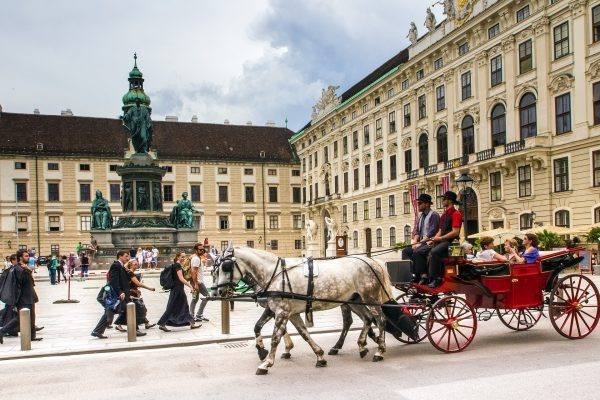
Schönbrunn Palace is the Habsburg summer residence and one of the finest Baroque palaces in Europe. Built by Maria Theresa in the eighteenth century, it has 1,441 rooms, gardens that stretch up a hill to a colonnaded viewpoint overlooking the city, and an interior that gives a specific and memorable sense of what it meant to be an emperor in the age of absolutism. The palace tour takes ninety minutes; the gardens can absorb another hour or two. The view from the Gloriette at the top of the hill — the palace below, the city extending behind it, the Vienna Woods on the horizon — is one of the best in Central Europe.
The Belvedere is a pair of Baroque palaces set in formal gardens in the centre of the city, built for Prince Eugene of Savoy, the general who defeated the Ottoman army at Vienna in 1683. The Upper Belvedere houses the permanent collection of Austrian art, including Klimt's The Kiss — one of the most recognisable paintings of the twentieth century — and several other major Klimt and Schiele canvases. The Lower Belvedere and the Orangery hold temporary exhibitions. The garden between the two palaces, with its fountains and sphinxes and the view across to the city centre, is itself worth the visit.
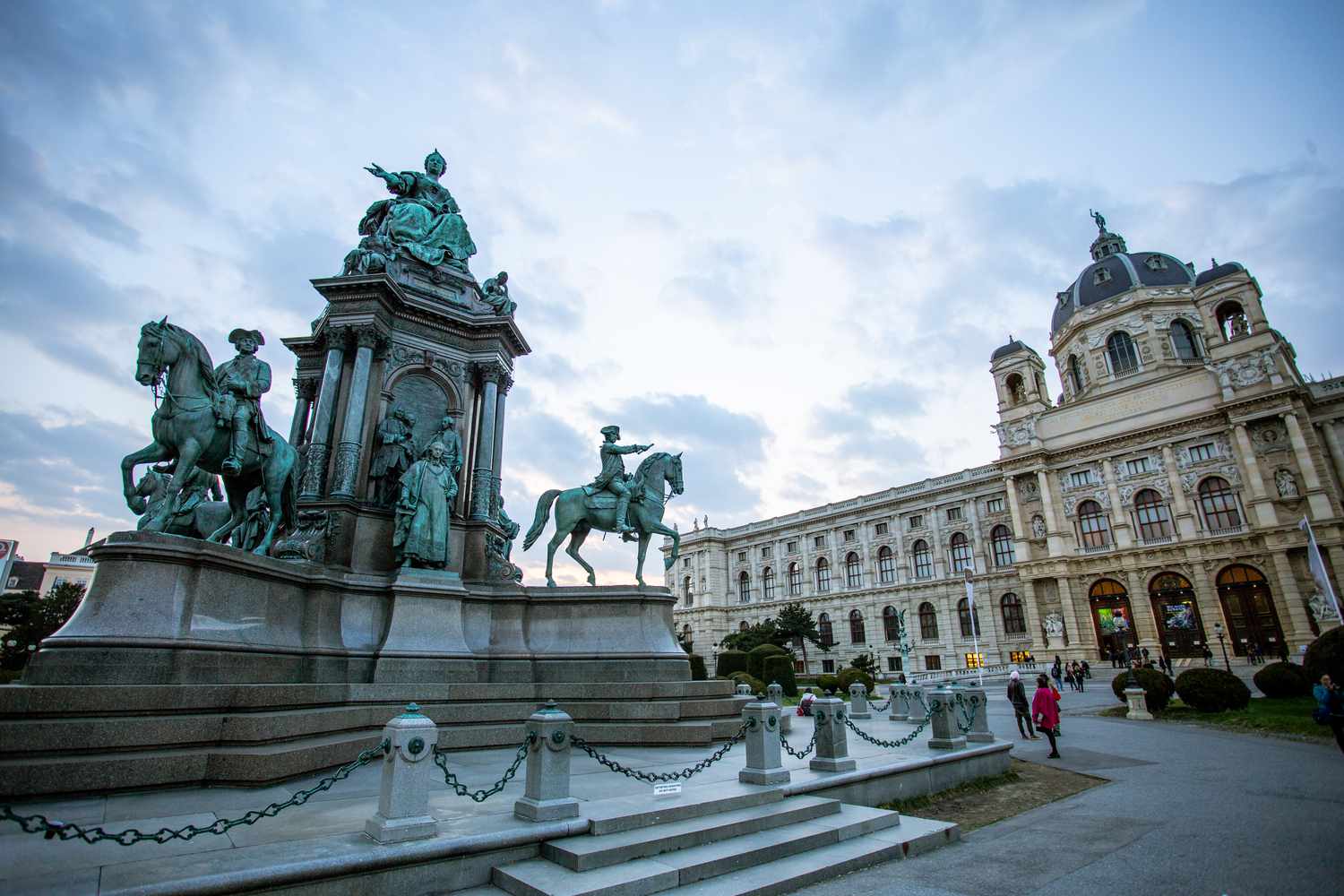
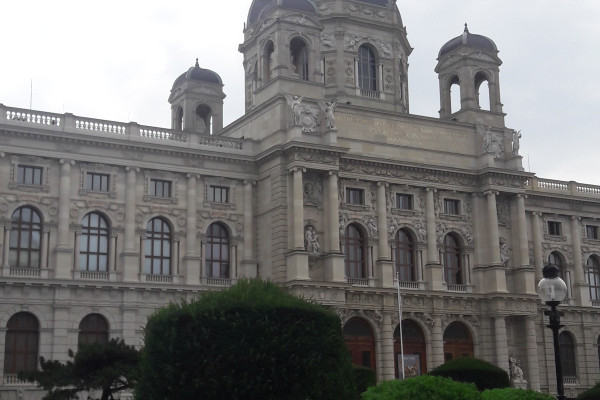
The Ringstraße is the four-kilometre boulevard that Franz Joseph I built around the old city between 1857 and 1890, lined with the monuments of the Habsburg empire at its height: the State Opera, the Kunsthistorisches Museum, the Natural History Museum, the Parliament building, the City Hall, the Burgtheater. Each of these buildings was designed by a different architect in a different historical style — Gothic for the City Hall, Greek for the Parliament, Renaissance for the museums — which gives the boulevard the quality of a textbook of European architecture compressed into a single walk. Your guide will explain the sequence and the politics behind it.
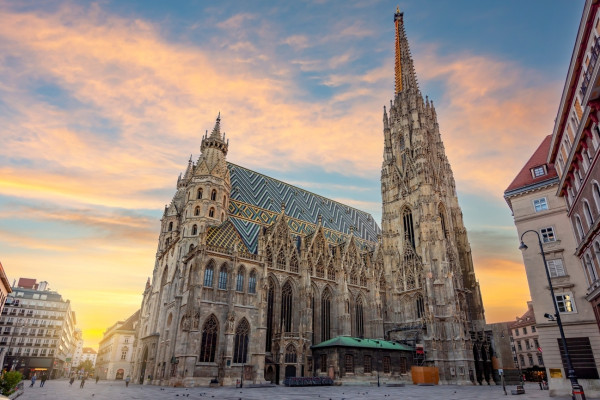
The Innere Stadt — Vienna's historic first district, a UNESCO World Heritage Site — is the old city enclosed by the Ringstraße. Stephansdom, the Gothic cathedral at its centre, has been standing since the thirteenth century and gives the district its skyline. The Graben and the Kohlmarkt are the main pedestrian streets — expensive, beautiful, and lined with the Habsburg-era shop facades that have barely changed in two centuries. The Hofburg, the winter imperial residence, takes up the entire western edge of the Innere Stadt and contains the Imperial Apartments, the Spanish Riding School, the Sisi Museum, and the Imperial Treasury.
Vienna Coffee Houses
Vienna's coffee house culture is not a tourist attraction — it is the city's actual daily life, and it has been since the seventeenth century. A Viennese coffee house is a place where you sit for as long as you wish, order a single Melange (the standard Viennese coffee, espresso with steamed milk), and read the newspapers the house provides on wooden holders. The waiter brings water with the coffee, refills it without being asked, and does not bring the bill until you request it. There is no expectation that you will leave.
Café Central, in a former palace on the Herrengasse, is the most famous — Sigmund Freud, Leon Trotsky, and Adolf Hitler all sat here before the First World War. Café Hawelka has been open since 1939 and has barely changed. Café Landtmann, beside the Burgtheater, is where the Austrian government and the theatre world still take their coffee. Any of these is worth a half-hour visit for the interior alone, and all of them serve proper food.
Vienna in December — Christmas Markets
Vienna in December is one of the finest versions of the city. The Rathausplatz Christmas Market — in front of the illuminated neo-Gothic City Hall — is the largest and most elaborate in Austria: hundreds of stalls, an ice rink in front of the building, and the City Hall itself lit up behind everything in a way that makes it look like something from a fairy tale. It runs from mid-November through Christmas Eve and draws enormous crowds in the evenings, particularly at weekends.
The Schönbrunn Palace Christmas Market is smaller and considerably more atmospheric: held in the palace courtyard with the Baroque facade as the backdrop, it sells traditional crafts and Austrian food in a setting that the Rathausplatz market, for all its size, cannot match for elegance. The Belvedere Christmas Market, in the palace gardens, is similar in character — quality goods, a beautiful setting, and fewer people than the main city markets.
December in Vienna is also the month of Advent concerts in the churches — the Jesuitenkirche, the Peterskirche, the Augustinerkirche — and the Vienna Philharmonic's New Year's Concert preparations, which make the whole city feel slightly more musical than usual. It is an excellent month to visit, particularly for those combining Vienna with Salzburg and Innsbruck on the 10-day Christmas markets tour from Prague.
Practical Tips for Visiting Vienna from Prague
Start early. If you are doing Vienna as a day trip, departure from Prague at 6:30–7:00 puts you in the city by 10:00–10:30. That gives you a full six hours before you need to think about the return journey. Schönbrunn alone takes two hours; plan accordingly.
Currency. Austria uses the euro. The Czech Republic uses the Czech koruna. Bring euros from Prague or withdraw from an ATM in Vienna. Exchange offices charge significant fees.
The U-Bahn is excellent. Vienna's metro covers the entire city and runs every few minutes. A 24-hour ticket costs €8 and covers all public transport in the city. From the Hauptbahnhof, the U1 line reaches the Stephansdom in seven minutes.
Book Schönbrunn in advance. In summer and December, Schönbrunn sells out the Grand Tour tickets by midday. Book online the day before or earlier. The gardens are free and do not require a ticket.
Museum pass. The Vienna City Card (€17 for 24 hours) covers public transport and gives discounts at most museums. If you are visiting both Schönbrunn and the Belvedere, a combined ticket saves money over buying separately.
Dinner reservations. Vienna's best restaurants — Steirereck, the Palmenhaus, Zum Wohl — require advance booking, particularly in December. If you are staying overnight, book dinner before you leave Prague.
We offer a four-day private tour from Prague covering Vienna, Salzburg, and Hallstatt — the most complete way to experience this route. For Vienna combined with the Austrian Christmas markets, see the 10-day Austria tour covering Vienna, Salzburg, Hallstatt, and Innsbruck. And if Salzburg interests you specifically, our Salzburg from Prague guide covers it in detail.
Frequently Asked Questions
How far is Vienna from Prague?
Vienna is approximately 330 kilometres from Prague by road — about three and a half hours of driving. By direct train the journey takes just under four hours. There is no practical direct flight.
Can you do Vienna as a day trip from Prague?
Yes — it is one of the most popular day trips from Prague. Three and a half hours each way leaves five to six hours in Vienna, which is enough for Schönbrunn, the Belvedere, and the Innere Stadt if the day is planned well. An overnight stay is considerably more comfortable and allows the city the time it deserves.
What is the best way to get from Prague to Vienna?
The direct train is convenient for solo travellers and couples. A private car with guide is better for groups of three or more — cost-competitive with first-class train tickets, door-to-door, and far more flexible. The drive through south Moravia is also genuinely scenic.
What is the best time to visit Vienna from Prague?
April through June and September through October offer the best combination of good weather and manageable crowds. July and August are the busiest months — the palaces and museums fill up and hotels are expensive. December is excellent for the Christmas markets and the atmosphere. January and February are quiet and cold, with good museum access and no queues.
How much does a private tour from Prague to Vienna cost?
A day trip to Vienna with a private guide and car starts from approximately €590 per group. Our four-day Prague–Vienna–Salzburg–Hallstatt tour, which gives each destination proper time, starts from €3,790 per group of up to four people. No prepayment is required.
What languages does the guide speak?
English, Russian, and Ukrainian. Please indicate your preferred language when booking.